




Start shopping for a Dubai pergola and you quickly notice that one word is being used for five quite different structures: a tensioned textile sail, an engineered membrane roof, a solid sheet or panel canopy, a folding-arm awning and an aluminium frame with rotating louvres. In a rendering they all look like shade. After three or four summers in the Gulf they behave nothing alike.
This guide compares those five executions along the criteria that actually decide the outcome here, rather than the ones that fill generic listicles. How the material ages under desert ultraviolet light. Whether heat sits under the deck or escapes through it. What a shamal day leaves behind, and how hard it is to get off again. What happens on the handful of December and February days when it really rains, and how each type behaves in gusts. Finally, the questions nobody asks until later: how much attention each one needs per year, and whether you can add light, a fan or side elements once it is standing. At the end there is a comparison table, a decision matrix by use, and a list of what you can usefully check on your own terrace during the cool season.
We build aluminium louvred pergolas, so read the recommendation with that in mind, and read the section that names the situations in which a shade sail or an awning is genuinely the better buy. Those situations exist and they are not rare. Prices for third-party work, permit fees and structural calculations are out of scope; where regulation matters, this article quotes only what is actually written in Dubai rules and tells you who to ask for the rest.
Key takeaways
- The comfort gain from any cover in this climate is mostly radiant, not thermometric: in hot arid cities, mean radiant temperature has been measured 20 to 30 °C lower under dense tree shading, while air temperature moves far less [1]. Those are urban-microclimate measurements, not product figures.
- A solid deck is not automatically the hot option, and a permeable one is not automatically the cool one. Heat build-up depends on whether the underside can ventilate; natural convection in a channel under an outer skin carries residual heat away, with channel width a governing parameter above roughly 6 cm [2]. That is a design decision, not a property of solid roofs.
- Fabric ages fastest at the start of its life. For structural polyester, the dominant mechanism under combined heat, humidity and ultraviolet light is chain scission from photodegradation, with the effect flattening out after roughly 1,000 hours of accelerated weathering [3] — and desert exposure is harsher than European figures suggest, with solar and ultraviolet irradiance around 50 % higher than in non-desert environments [4].
- Dust is a design input, not a cosmetic nuisance. Measurements on inclined outdoor surfaces in UAE conditions show the pattern plainly: slope sheds dust, flat collects it [5]. Give any deck a fall.
- Rain is the rarest load and the most demanding one: only 2.8 days in January and 3.4 days in March bring 1 mm or more [6], yet on 16 April 2024 Dubai Airport recorded 144 mm in a day, about one and a half years of rain [7].
- In Dubai, no works that permanently or temporarily change the features of a property may be carried out without a permit from the competent department [8], and additions or modifications to an existing building fall inside that definition [9]. Confirm the specific requirement for your plot before you order.
The five shade structures Dubai villa owners actually choose between
Before comparing anything, it helps to separate the five executions properly. They differ in what carries the load, what forms the cover, and what happens to each part over time.
The textile shade sail
A woven or knitted cloth, usually a high-density polyethylene mesh or a coated polyester, tensioned between masts, wall plates and ground anchors. The cloth itself carries the load in tension, so geometry is everything: a sail only works if it is twisted into a hypar shape with enough curvature to stay tight. It is the cheapest way to cover an awkward area and the easiest to remove. It is also the execution in which the cover and the structure are the same component, so when the fabric ages, the whole shade ages with it.
The engineered tensioned membrane
Visually related to a sail but a different product: a coated architectural fabric, cut from a calculated pattern, pre-stressed over steel or aluminium masts with proper edge cables and adjustable corner fittings. Spans are far larger, the surface stays visually taut for much longer, and the engineering is not optional. In a villa context you mostly see these over driveways, large courtyards and pool decks. Treat any round service-life number a supplier quotes as a claim to be substantiated, and ask which exposure standard it refers to.
The fixed solid canopy
A permanent roof made from aluminium sheet, insulated sandwich panel or polycarbonate on a steel or aluminium frame. It is the simplest thing to build and the most absolute: full shade, full rain cover, no adjustment. Everything depends on three details most quotes do not mention — the fall of the deck, where the water is collected, and whether the underside can breathe. Get those right and it is a strong solution. Get them wrong and you have a hot, badly draining lid that you cannot change without rebuilding it.
The folding-arm textile awning
A fabric cover on spring-loaded or motorised arms, fixed to the villa wall or fascia, retracting into a cassette. Its defining quality is that it disappears. On a December afternoon you retract it and get the sun back; in summer you extend it over a dining area. Its defining limitation is the same: it depends on a wall to fix to, and it has to be retracted before the wind picks up. Its fabric also lives the same ultraviolet-limited life as a sail.
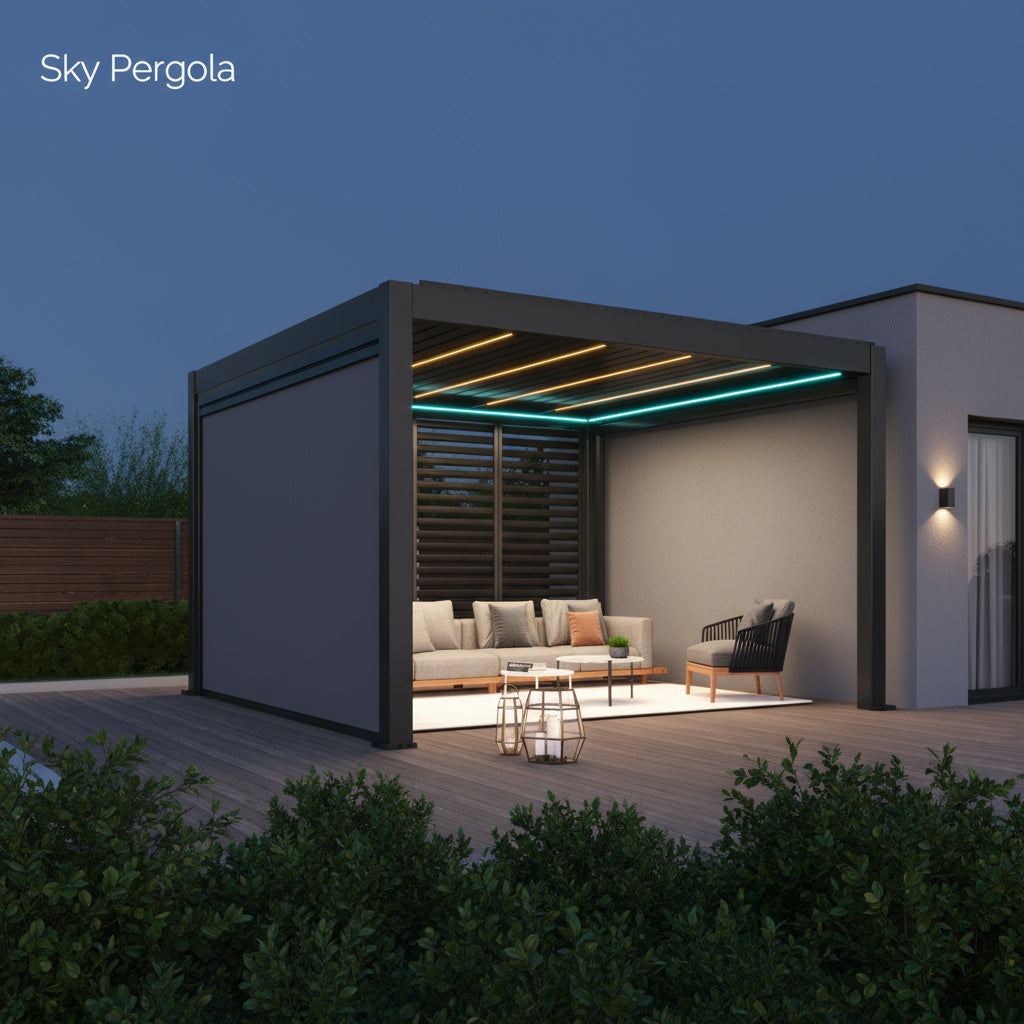
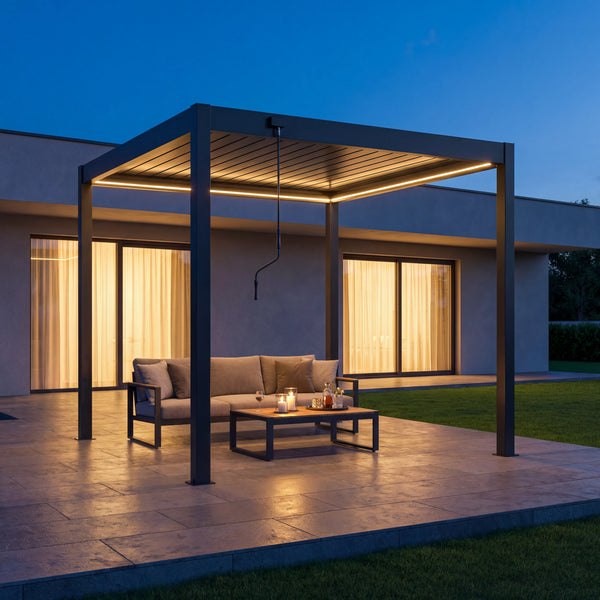
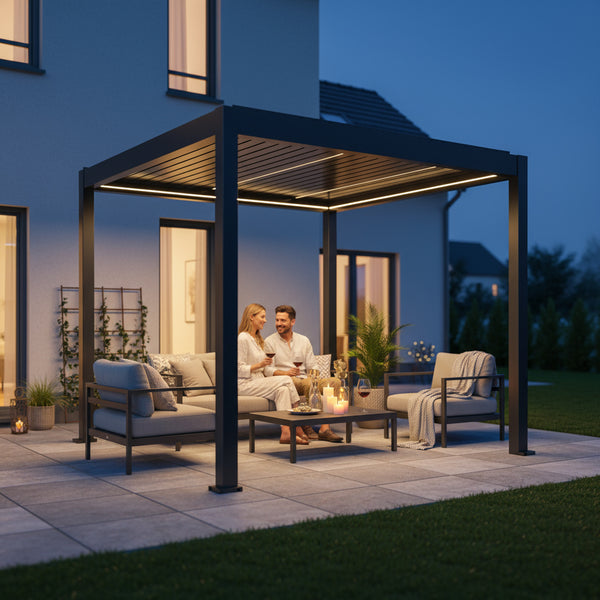
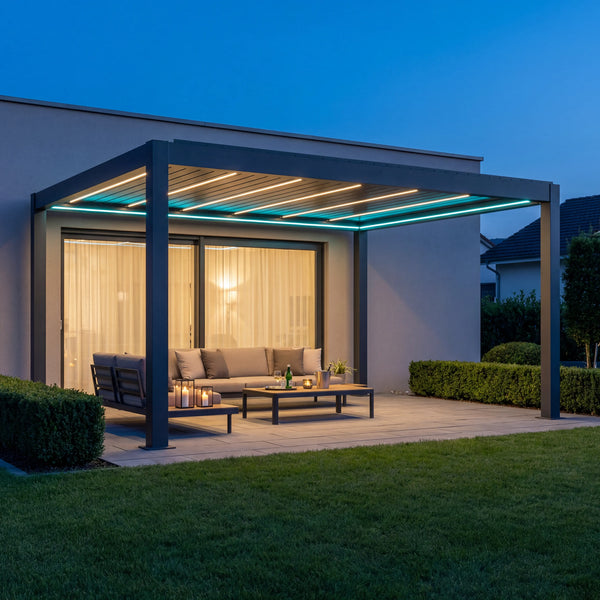
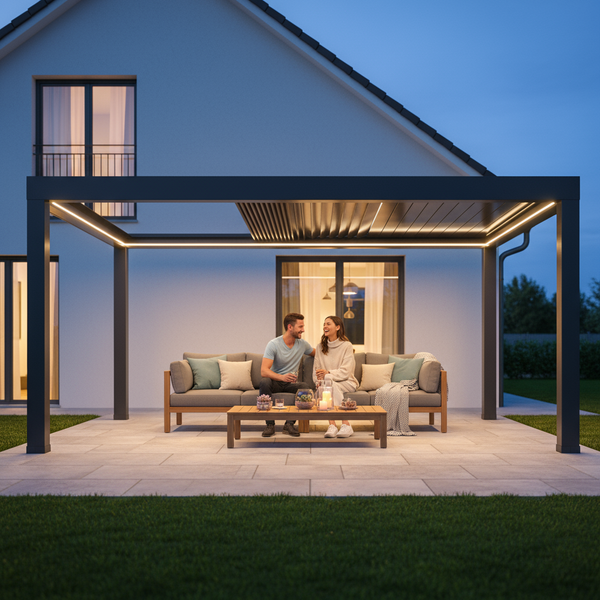
The aluminium pergola with rotating louvres
A self-supporting powder-coated aluminium frame whose roof is built from parallel blades that pivot, typically through roughly 0° to 135°. Closed, the blades overlap into a sealed deck that sheds water into gutters inside the frame and down the posts. Open or part open, the same roof becomes a ventilated grid. The frame is permanent and the cover is adjustable, which is the structural reason this category behaves differently from all four of the others: the shading adapts to the hour instead of being fixed at the time of purchase. You can read how the blade angle works in practice on our page on how rotating louvres beat the heat in Dubai.
What the Dubai climate really does to a cover
Most comparisons you will find treat the UAE as simply hot. The load on a shade structure here is more specific than that, and it falls in a predictable annual pattern.
The heat and ultraviolet budget
At Dubai International Airport, the 1991 to 2020 climate normals give a mean daily maximum of 41.9 °C in August and 24.4 °C in January, a swing of 17.5 K that every component lives through each year [10]. The extremes matter more for fixings and surfaces than the means: the highest daily maximum in the same normals reaches 48.8 °C in August and still 46.3 °C in May [11]. The ultraviolet load barely pauses either, with 350 hours of sunshine in May and still 256.9 hours in December [12]. On top of that, solar and ultraviolet irradiance in desert environments run around 50 % higher than in non-desert locations [4], which is the single best reason to distrust any service-life number borrowed from European or North American exposure.
The nights that do not cool down
In a temperate climate, a terrace recovers overnight. Here it does not: the mean daily minimum is 31.2 °C in July and 31.5 °C in August [13]. That changes what you should ask of a cover. A structure that merely blocks the sun, while holding warm air underneath it, gives you very little between June and September. Airflow is not a luxury feature in this climate, it is half the product.
Dust season has a calendar
The summer shamal is seasonal rather than random: it typically begins around 30 May, subsides by about 16 August, and reaches its peak speed each day near noon [14]. It takes wind over 11 metres per second, about 40 km/h, to lift enough dust to push visibility below 3.5 km [15] — in practice, those are the days that leave a visible film on everything. Knowing the window is useful: it tells you that the cleaning burden is concentrated in the months you use the terrace least, and that it is heaviest around the middle of the day.
Rain that arrives all at once
Almost all Dubai rain falls in the cool season. The normals give 20.8 mm in January, 9.9 mm in February, 21.7 mm in March and 14.8 mm in December, against 0.003 mm in August [16]. The number of days carrying 1 mm or more is tiny: 2.8 in January, 2.4 in February, 3.4 in March and 3.4 in December [6]. So a roof's drainage is used on a handful of days a year — and on those days it is used hard. The 16 April 2024 event is the reference case for what the tail looks like: a 24-hour total of 259.5 mm set an all-time UAE record, and Dubai Airport alone recorded 144 mm, around one and a half years of rain in one day [7].
Ageing and shape stability after three or four summers
This is where the five executions separate most sharply, and it is the criterion almost no comparison covers with a mechanism rather than a round number.
Fabric and membrane: strength goes before looks do
For uncoated structural polyester fabrics, laboratory weathering shows that the dominant cause of tensile-strength loss under combined heat, humidity and ultraviolet attack is chain scission driven by photodegradation, not moisture, and that the degradation is steepest early, reaching a plateau after roughly 1,000 hours of accelerated exposure [3]. Two practical consequences follow. First, a sail that still looks acceptable may already have given up a meaningful share of its strength, so visual inspection is not a safety check. Second, because desert irradiance is about 50 % higher than non-desert exposure [4], the early steep phase arrives sooner here than the fabric datasheet implies. Plan a textile cover as a wearing part with a replacement budget, not as a permanent roof.
Frames and coatings: the one specification question worth asking
For any metal structure, the frame alloy is rarely the weak point; the finish is. Architectural powder coatings are graded by real outdoor exposure in Florida rather than by laboratory tests alone, with Class 1 tested for one year, Class 2 for three years and Class 3 for ten [17]. The thresholds are the useful part: a Class 1 standard coating only has to retain 50 % of its gloss after twelve months of that exposure, whereas a Class 3 hyper-durable coating must still hold 80 % after three years and 50 % after ten [18]. So instead of asking whether a frame is powder-coated, ask which class of coating it carries and what the gloss-retention commitment is. That one question separates a frame that still looks right in year six from one that chalks in its second summer. Salt-laden coastal air puts an additional load on coating and fixings, so ask about the coating class for a seafront plot and about stainless-steel fasteners. Our page on why aluminium suits the Dubai climate goes through the material side in more detail.
Movement: why long spans need somewhere to go
Architectural aluminium extrusions are typically alloy 6063-T6, which expands about 23.5 micrometres per metre per kelvin and conducts heat at roughly 201 watts per metre-kelvin [19]. The useful part is not a single figure but the direction it points in: a long member that heats through a Dubai day gets measurably longer, and a frame rigidly fixed at both ends has nowhere to put that movement, which is how louvre mechanisms begin to bind and joints begin to rattle. Ask how movement is accommodated rather than assuming it does not have to be. The high conductivity has a second, more mundane implication: a sun-warmed aluminium surface transfers that heat to your hand immediately, which is an argument for keeping posts and handles out of the afternoon sun where you can.
Heat under the cover: sealed deck versus back-ventilated deck
The common claim is that fabric breathes and therefore feels cooler, while a solid roof traps heat. That is only half right, and the halves matter.
Radiant temperature is what you actually feel
In hot arid cities, the comfort gain from a cover comes overwhelmingly from cutting radiant load rather than air temperature. A systematic review of 120 studies reports mean radiant temperature reductions of 20 to 30 °C under dense tree shading [1]. These are urban-microclimate measurements, not product figures, so do not read them as a performance claim for any canopy. The directional lesson is solid though: the denser and more opaque the cover, the more radiant load it removes. A permeable mesh that lets a share of direct sun through keeps a share of the radiant load with it.
Why a ventilated gap changes the answer
The reason solid roofs earned their reputation is not their opacity, it is sealed undersides. Research on a double-skin roof shows that natural convection in the air channel beneath the outer skin drives off residual heat, with the channel width being a governing parameter above roughly 6 cm [2]. In other words, a solid deck that can vent behaves very differently from one that is boxed in — and a rotating louvre deck is a controllable version of exactly that principle, because tilting the blades opens a path for hot air to leave upwards instead of accumulating. Given how little Dubai's summer nights cool down [13], that path is worth more here than it would be almost anywhere else.
Depth and sides matter as much as the roof
Geometry alone does measurable work. The same review finds that enclosure with a height-to-width ratio above roughly 0.6 to 0.8 cuts midday mean radiant temperature by 15 to 25 °C [20]. Again, that is a city-canyon finding rather than a pergola specification, but it explains something buyers often learn too late: a wide, shallow cover that leaves low western sun streaming in under the edge performs worse than a deeper structure with one closed side. If your terrace faces west, the side element is not an accessory, it is part of the shading.
Dust, showers and gusts: the weather events that shape the design
How often you will actually be cleaning
Dust deposition on inclined outdoor surfaces in this climate has been quantified mostly in solar research, which is where the measurements exist. In UAE field tests on PV modules, build-up on a flat surface was 37.63 % higher than on a clean reference, against 14.11 % at 25° and 10.95 % at 45° [5]. The same work found that leaving surfaces uncleaned carries a measurable cost: roughly a 10 % annual performance loss versus cleaning once a month, and a 29.76 % loss for uncleaned modules versus daily cleaning [21]. Those percentages are about solar output and do not transfer to a pergola. The physics does: a flat deck collects markedly more than a sloped one, and dust left through a humid coastal night cements itself in place. Practically, this favours smooth sloped metal that a hose will clear, and penalises textured fabric with a mesh structure that holds grit. During shamal season [14] a rinse every few weeks is realistic; outside it, far less.
Drainage, not waterproofing
Because rain falls on so few days [6], the question is never whether a cover gets wet but where the water goes when it does. A permeable sail passes it straight through onto the furniture. A solid canopy or a closed louvre deck collects everything and delivers it to one or two points, which is where most disappointments originate: an outlet discharging onto the walkway you use, or a gutter sized for an average March day rather than for an April 2024 day [7]. Honest language matters here. A properly built louvre roof with an integrated rain drainage system is rainproof and will carry the short winter showers [16] without ending the evening; in an extreme storm, water can by construction still get in at the edges. Treat anyone promising an absolutely waterproof outdoor roof with suspicion, and ask instead for the drainage route on paper — our page on how a louvre roof pergola handles rain and drainage goes through the principle.
Gusts: flutter, re-tensioning and uplift
For a free-standing cover, the critical wind case is not downward pressure but uplift and skew. Within the Trakhees-regulated areas of Dubai, wind loads are calculated to ASCE 7, and the guidance explicitly requires directions other than the two orthogonal ones to be investigated for ultimate and serviceability limit states [22]. Which design values apply to your own plot is a question for the authority with jurisdiction over your community and for whoever signs off the structure, not for a buying guide.
The qualitative failure modes, on the other hand, are what you will actually live with. A sail that loses tension starts to flap, and flapping accelerates wear at the corners while the noise ends the evening; expect re-tensioning as routine maintenance rather than as a warranty event. A folding-arm awning has to be retracted before gusts arrive, which makes it a device that depends on someone being there or on a timer being right, and the fixing into the villa wall takes the full lever of the extended arms. A fixed canopy gives you nothing to operate and nothing to forget: its load goes into its anchors, so it either holds or it does not, and the anchors are the part worth paying attention to. A louvre roof turns its blades edge-on, which reduces the surface the wind can push against, and its wear point is the mechanism rather than the cover. Note also that the wind that lifts dust starts at a modest 11 metres per second [15] — long before anything structural is at risk, fabric is already moving.
Maintenance, retrofits and how much control you need
A realistic yearly rhythm
A textile sail needs seasonal tension checks, corner and fitting inspection, and a cloth replacement cycle you should budget for from day one. A membrane needs less frequent but more specialised attention, since re-tensioning is a job for the installer. A fixed canopy needs its gutters and outlets cleared before the cool season and its fixings checked, and little else. An awning needs the cassette and arms kept clean of grit and the fabric inspected at the hem. A louvre roof needs the gutters inside the frame cleared, the blades rinsed, and the mechanism kept free of fine sand. Across all five, the one job that is genuinely non-optional before December is clearing the drainage path.
Adding light, a fan and side elements later
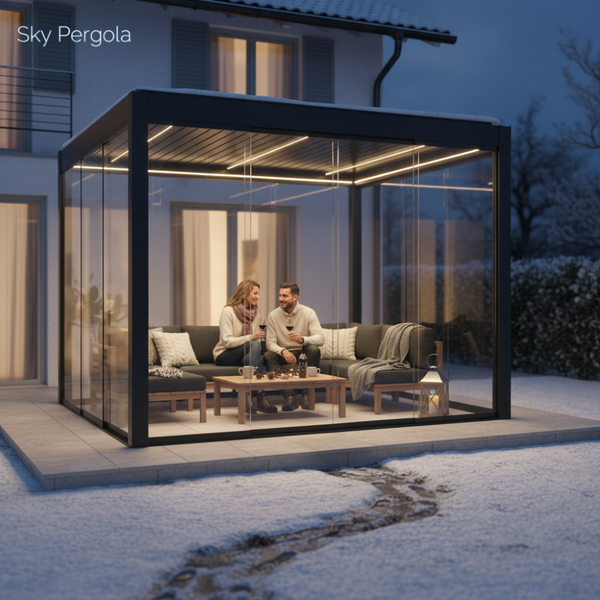
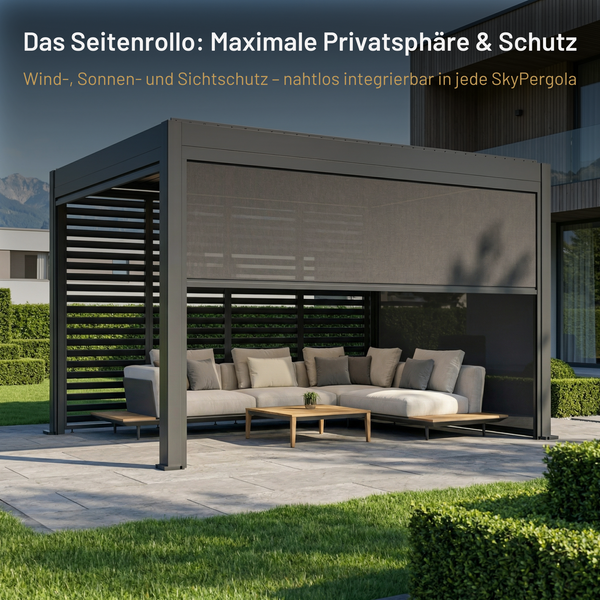
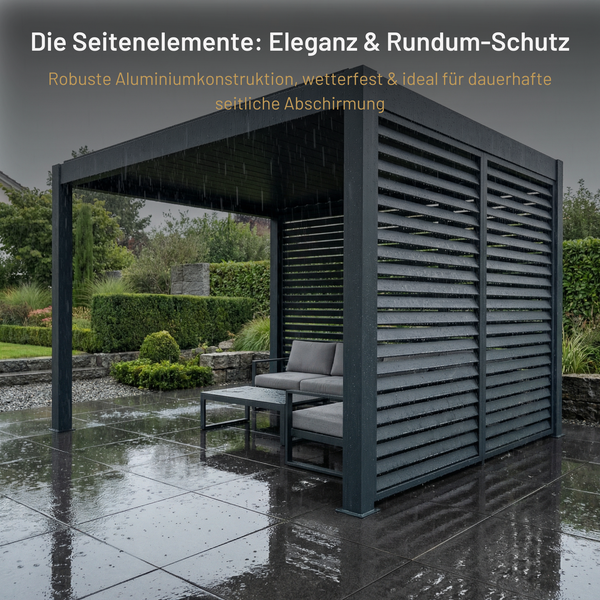
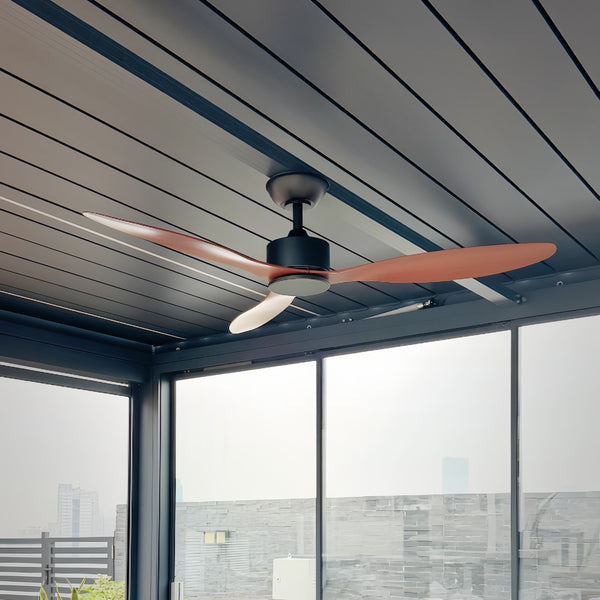
This is the blind spot in every comparison we reviewed, and it is the biggest single practical difference between a textile cover and a framed system. A sail has no load path for a fan, no cable route for lighting and no way to take a vertical screen; anything you add has to be fixed to the house or to separate posts. A membrane is similar, with the added complication that penetrating the fabric is not an option. A fixed canopy can usually take a light and a fan if someone thought about cable routes during fabrication, and cannot if nobody did. A framed louvre pergola is the one case where retrofit is normal rather than improvised: lighting sits inside the frame, and a pergola fan with multi-speed remote control and vertical elements such as a pergola side blind against wind, sun and prying eyes can be added to the structure. If there is any chance you will want evening use, cooling airflow or a closed western side later, decide that now — it is cheaper at the configuration stage than at any point afterwards.
Fixed or adjustable
Fixed shade is a bet on one condition. It is the right bet for a walkway, a carport or a utility area, where you want unambiguous cover and never want to think about it again. It is the wrong bet for a dining terrace that you want to use at 13:00 in July and at 19:00 in January, because the same amount of cover cannot be right for both. Adjustability has a price — a mechanism, a motor, and a part that can eventually need service — and the honest question is whether your use varies enough to earn it. For a main villa terrace in Dubai, where the usable season runs from roughly October to April but the summer evenings are also in play, it usually does; our page on roofs that open and close sets out what that control actually covers.
Dubai pergola, sail or canopy: the comparison at a glance
Five executions against eight criteria
| Execution | Ageing and shape stability | Heat under it | Dust and cleaning | Rain and drainage | Behaviour in gusts |
|---|---|---|---|---|---|
| Textile shade sail | Cover is the structure; strength falls fastest early [3] and desert exposure accelerates it [4] | Permeable, so some direct sun and radiant load pass through | Mesh holds grit; hardest of the five to rinse clean | Water passes straight through onto the area below | Flutters as tension is lost; periodic re-tensioning expected |
| Tensioned membrane | Stays visually taut longest of the textiles; engineered pattern | Opaque, so good radiant reduction, but underside is not ventilated | Coated surface sheds dust better than mesh; large areas need access | Sheds water to designed low points; needs ground drainage below | Strong when pre-stress is correct; re-tensioning is a specialist job |
| Fixed solid canopy | Durability set by coating class rather than by substrate [17][18] | Good radiant cut; feels hot only if the underside is sealed [2] | Smooth and hose-friendly if given a fall; a flat deck collects most [5] | Full cover; everything depends on gutter and outlet sizing | Load goes into anchors; uplift and skew govern [22] |
| Folding-arm awning | Fabric is a wearing part; mechanism and cassette outlast it | Opaque cover, open sides, retracts fully for winter sun | Fine sand in arms and cassette is the main concern | Light showers only; not a rain roof | Must be retracted before gusts; full lever into the wall fixing |
| Aluminium louvred pergola | Permanent frame, adjustable cover; coating class decides the look over time [17] | Closed for radiant cut, tilted to vent heat upward [2] | Smooth blades rinse down; mechanism needs to stay sand-free | Rainproof closed, with gutters inside the frame and posts as downpipes | Blades turn edge-on; wear sits in the mechanism, not the cover |
| Execution | Attention per year | Retrofit of light, fan, sides | Adjustability |
|---|---|---|---|
| Textile shade sail | Tension checks, fittings, planned cloth replacement | Not possible on the cover; needs separate posts or house fixings | None once installed; removable seasonally |
| Tensioned membrane | Low but specialised; installer-led re-tensioning | Very limited; fabric must not be penetrated | None |
| Fixed solid canopy | Clear gutters and outlets before the cool season; check fixings | Possible if cable routes were planned during fabrication | None |
| Folding-arm awning | Keep arms and cassette free of grit; inspect hem and fabric | Limited to what the wall can carry | Full open or closed, but no control over shade density |
| Aluminium louvred pergola | Clear frame gutters, rinse blades, keep the drive sand-free | Designed for it: lighting in the frame, fan and vertical elements can be added | Blade angle from closed to open, so shade and airflow are set separately |
Decision matrix by use
| Where you need shade | What actually decides it | Usually the best fit | Honest alternative |
|---|---|---|---|
| Dining area at the villa | Midday radiant load, evening use, rain cover for the cool season, low western sun | Louvred aluminium pergola with one closed side | Fixed canopy with a ventilated underside, if you never want adjustment |
| Lounge or poolside | Airflow on nights that barely cool down [13], glare at low sun, splash and dust | Louvred pergola, blades tilted rather than closed | Membrane over a large irregular pool deck |
| Walkway, entrance, carport | Unambiguous cover, zero attention, water routed away from the path | Fixed solid canopy with a proper fall | Shade sail where the span is awkward and cover need not be complete |
| Roof terrace | Fixing substrate, parapet condition, uplift rather than downward load [22] | Framed structure anchored to an engineered point, specified for the wind figure that governs your plot | Ballasted or removable sail or awning where penetrations are not permitted |
Honest cases: when a sail or an awning is the better answer
There are five situations in which we would not recommend a pergola. First, a rented villa: a permanent frame you cannot take with you is poor value, and a sail or a cassette awning is the rational choice. Second, a roof terrace or podium where you are not allowed to penetrate the waterproofing and no engineered fixing point exists — a removable or ballasted solution may be the only lawful one, and that is a question for your building management, not for a supplier. Third, an irregular courtyard where no rectangle fits: a sail or a cut membrane follows odd geometry that a frame cannot. Fourth, a terrace where you specifically want the winter sun back: December still delivers 256.9 hours of sunshine [12], and a retractable fabric cover gives you all of it when you want it; our own motorised SkyShade LED awning exists for exactly that case and is an awning, not a pergola. Fifth, a limited budget on a large area: a sail covers more square metres per dirham than anything else, as long as you accept it as a wearing part.
What you can check on site in the cool season
November to March is when most of these decisions are made, and it is a good window for measurement because the sun sits low enough to show you the problem. Walk the terrace at 09:00, 13:00 and 16:00 and mark how far the low sun reaches under the proposed edge; that penetration depth, not the footprint, is what decides whether you need a side element. Pour a bucket of water on the terrace and watch which way it runs, then compare that with where a closed roof would discharge its water. Establish what you are actually fixing into — slab, screed and tile, timber deck or parapet — because that determines the anchoring. Note where fine dust already accumulates after a windy day, since that is where it will accumulate on a flat deck too [5]. And check where your prevailing afternoon breeze comes from, because a cover that blocks it costs you more comfort than it gives you.
Permits and approvals: one principle
Assume that approval is needed, and have it confirmed before you order anything. In the Emirate of Dubai, no person may implement construction works that permanently or temporarily change, in whole or in part, the features of any land or real property without first obtaining the relevant permit from the competent department [8], and the same Local Order defines construction works to include additions or modifications to buildings, not only new buildings [9]. The area thresholds, height limits and fee figures that circulate on forums and supplier pages could not be traced to any official text, so put the question to the authority with jurisdiction over your community instead, ask your master developer whether a community no-objection certificate is required, and ask your supplier in writing who submits what.
Where the Sky Pergola models fit
Our range sits in one of the five categories above: powder-coated aluminium frames with rotating louvre roofs, designed in Switzerland and supplied across the UAE with prices shown in AED including VAT. The models differ mainly in size, in how the roof is operated, and in the structural figures given for each.
The SkyLite ECO aluminium pergola is a 3 x 3 m frame with a manual louvred roof, integrated LED lighting and a drainage system running through the louvres, gutters and posts; it withstands winds up to 120 km/h and starts from AED 21,555. The SkyMotion LED aluminium pergola is the same footprint with a motorised louvred roof, also rated to 120 km/h, from AED 28,755 — the entry point if you want blade control without operating the roof by hand. The SkyMax Ultra aluminium pergola covers 4 x 6 m with motorised, illuminated louvres and a wind resistance of up to 120 km/h, for a full dining-and-lounge terrace. The SkyInfinity Pro aluminium pergola goes further on both counts: its louvred roof retracts to open up to 70 % of the roof area, it is available from 3 x 3 m up to 4 x 6 m, and its stated wind resistance is up to 150 km/h, with the rainwater drainage integrated into the supporting posts.
One note in the spirit of this article: a louvre deck is only as good as its underside. Its advantage over a sealed canopy comes from tilting the blades so warm air leaves upward [2], so if your plan is to keep the roof permanently closed, the honest comparison is against a fixed canopy, not in favour of louvres.
The recommendation, and the one thing to settle first
For a main villa terrace in Dubai — the dining and lounge area you want to use from October through April and on summer evenings — an aluminium louvred pergola is the execution that answers the most of this climate at once: an opaque deck when the radiant load is the problem [1], a ventilated grid when the problem is a night that stays above 31 °C [13], smooth surfaces for shamal dust [14], gutters for the three or four days in March that matter [6], and a permanent frame that will still take a fan, a light or a closed side in three years. For a walkway or a carport, a fixed canopy with a proper fall is the better and cheaper answer. For a rented villa, an undrillable roof terrace, an irregular courtyard or a large area on a tight budget, a sail or a retractable awning is genuinely the right call, and we would say so.
Whichever way you lean, settle one thing before you ask anyone for a quote: what the drainage and the fixing substrate on your terrace actually are. Every disappointment we see traces back to one of those two, not to the choice of cover. Once you know them, you can size and configure a structure properly — start in the Sky Pergola configurator, bring your terrace dimensions and the direction your low afternoon sun comes from, and ask us about anything the configurator cannot settle on its own.
Frequently asked questions
Does it get hotter under a closed roof than under a fabric sail?
Not necessarily. An opaque cover removes more radiant load than a permeable mesh, and in hot arid climates radiant temperature is what you feel, with reductions of 20 to 30 °C measured under dense tree shading in urban-microclimate studies[1]. What makes a solid roof feel hot is a sealed underside: natural convection in a ventilated channel beneath an outer skin carries residual heat away, with channel width governing above roughly 6 cm[2]. A louvre roof you can tilt gives you both options rather than one.
How often will I have to clean a shade structure in Dubai's dust?
Most of the work falls in shamal season, which typically runs from around 30 May to about 16 August and peaks near noon each day[14]. Expect a visible film after any day with wind over 11 metres per second[15]. Slope matters: on PV modules measured in UAE field tests, dust build-up on a flat surface ran 37.63 % above a clean reference against 10.95 % at 45°[5]. Only that tendency transfers to a shade deck, not the percentages. A smooth sloped surface needs a rinse every few weeks in summer; mesh fabric needs more.
Does a pergola keep the rain out during the winter showers?
A closed louvre roof with an integrated rain drainage system is rainproof and handles the short cool-season showers, which is almost all Dubai rain: 20.8 mm in January, 21.7 mm in March and 14.8 mm in December[16]. In an extreme storm, water can by construction still get in at the edges, so nobody should promise an absolutely waterproof outdoor roof. The 2024 record of 144 mm in one day at Dubai Airport[7] shows why gutter and outlet sizing deserves a conversation.
How long does powder-coated aluminium hold its colour here?
Ask for the coating class rather than a year count. Architectural powder coatings are graded by real Florida exposure: Class 1 for one year, Class 2 for three, Class 3 for ten[17]. A Class 1 coating need only retain 50 % gloss after twelve months, while Class 3 must hold 80 % after three years and 50 % after ten[18]. Bear in mind that desert solar and ultraviolet irradiance run about 50 % higher than non-desert exposure[4], so coating class matters more here.
Do shade sails flutter or need re-tensioning in shamal winds?
Yes, re-tensioning is routine rather than exceptional. Fabric starts moving long before anything structural is at risk, since dust-lifting winds begin at about 11 metres per second[15] and shamal days peak around noon[14]. Flapping accelerates wear at corners and fittings. Separately, structural polyester loses tensile strength fastest early in its life through ultraviolet chain scission[3], so a sail that still looks sound may already have aged. Plan seasonal tension checks and a replacement cycle.
What works on a roof terrace where I cannot dig foundations?
The deciding factors are the fixing substrate and uplift, not weight. For a free-standing cover, skew and uplift govern: in the Trakhees-regulated areas of Dubai, wind loads are calculated to ASCE 7 and directions other than the two orthogonal ones have to be investigated for ultimate and serviceability limit states[22]. Which design values apply to your own plot is a question for the authority with jurisdiction over your community. If penetrating the waterproofing is not permitted, a removable sail or awning may be the only option. Have the parapet and anchor points checked on site first.
Can I add lighting, a fan or side screens later?
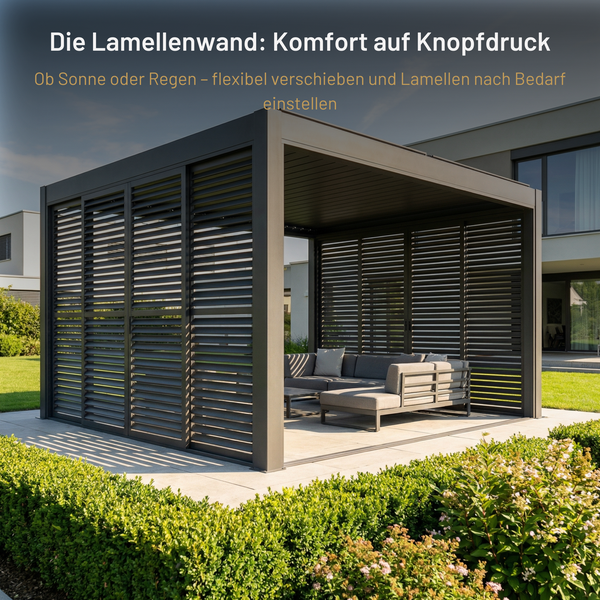
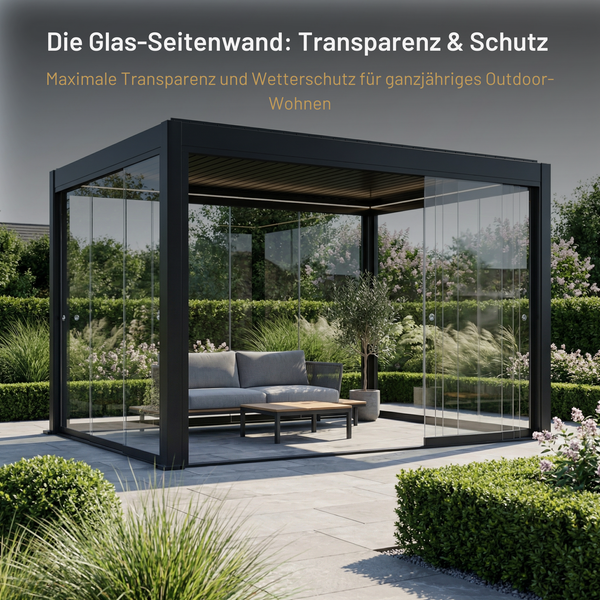
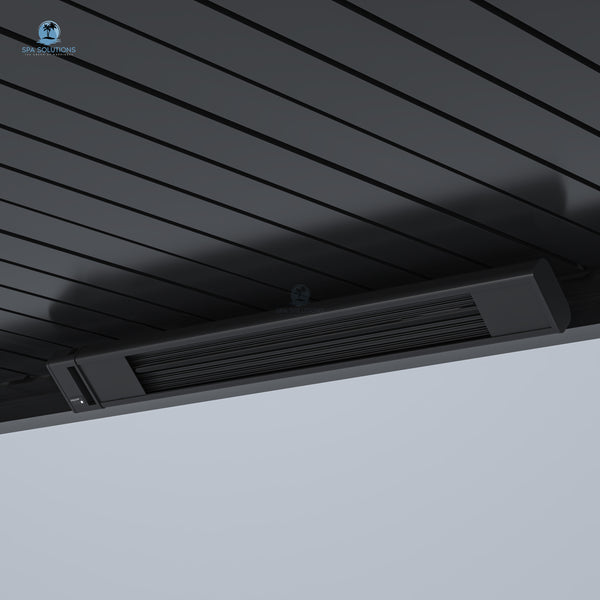
On a framed louvre pergola, yes: lighting sits inside the frame, and a fan, a side blind, a glass or louvre side wall or a 150 cm dark radiant heater can be added to the structure. On a sail or membrane there is no load path and no cable route, so anything extra has to go on the house or on separate posts. Decide early anyway, because a closed western side is often what makes the difference between a terrace you use at 17:00 and one you do not.
Sources
- Outdoor thermal comfort in hot arid MENA cities: a systematic review – Frontiers in Sustainable Cities, Elnabawi et al., 2026
- Heat transfers in a double-skin roof ventilated by natural convection in summer time – Biwole, Woloszyn & Pompeo, Energy and Buildings (preprint on arXiv), 2008
- Artificial Weathering Mechanisms of Uncoated Structural Polyethylene Terephthalate Fabrics with Focus on Tensile Strength Degradation – Materials (MDPI), Asadi et al., 2021
- A closer look at backsheet degradation in desert environments – pv magazine (reporting research by Hamad Bin Khalifa University, Qatar)
- Multi-criteria decision-making approach for the selection of cleaning method of solar PV panels in United Arab Emirates based on sustainability perspective – International Journal of Low-Carbon Technologies (Oxford University Press), Hachicha et al., 2022
- WMO Climatological Standard Normals for 1991–2020 — Dubai International Airport (41194) – NOAA National Centers for Environmental Information / World Meteorological Organization
- Unprecedented rainfall in the United Arab Emirates – ECMWF Newsletter No. 180, Magnusson, Hewson & Chevallier, 2024
- Local Order No. (3) of 1999 Regulating Construction Works in the Emirate of Dubai – Government of Dubai — Dubai Legislation Portal (Supreme Legislation Committee)
- Local Order No. (3) of 1999 Regulating Construction Works in the Emirate of Dubai – Government of Dubai — Dubai Legislation Portal (Supreme Legislation Committee)
- WMO Climatological Standard Normals for 1991–2020 — Dubai International Airport (41194) – NOAA National Centers for Environmental Information / World Meteorological Organization
- WMO Climatological Standard Normals for 1991–2020 — Dubai International Airport (41194) – NOAA National Centers for Environmental Information / World Meteorological Organization
- WMO Climatological Standard Normals for 1991–2020 — Dubai International Airport (41194) – NOAA National Centers for Environmental Information / World Meteorological Organization
- WMO Climatological Standard Normals for 1991–2020 — Dubai International Airport (41194) – NOAA National Centers for Environmental Information / World Meteorological Organization
- Sandy Shamal Season – NASA Earth Observatory (published 1 August 2018)
- Sandy Shamal Season – NASA Earth Observatory (published 1 August 2018)
- WMO Climatological Standard Normals for 1991–2020 — Dubai International Airport (41194) – NOAA National Centers for Environmental Information / World Meteorological Organization
- Why Florida Test for Architectural Powder Coating? – QUALICOAT UK & Ireland
- Why Florida Test for Architectural Powder Coating? – QUALICOAT UK & Ireland
- Aluminium Alloy 6063-T6 Extrusions — Data Sheet – Aalco Metals Ltd
- Outdoor thermal comfort in hot arid MENA cities: a systematic review – Frontiers in Sustainable Cities, Elnabawi et al., 2026
- Multi-criteria decision-making approach for the selection of cleaning method of solar PV panels in United Arab Emirates based on sustainability perspective – International Journal of Low-Carbon Technologies (Oxford University Press), Hachicha et al., 2022
- Building Regulation and Design Guidelines — Structural (Grey Code), January 2021 – Trakhees — Ports, Customs and Free Zone Corporation, Government of Dubai
Last updated: November 2026


